Accelerating beyond barriers
Meet the women who challenged stereotypes in motorsports, and opened doors for more women on the track and behind the scenes.
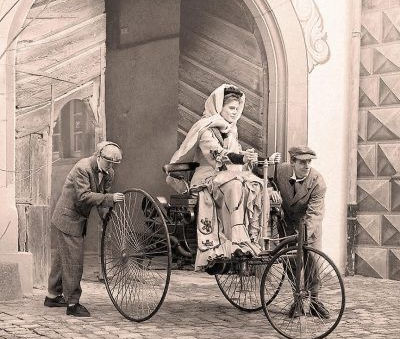
Bertha Benz
The first person in history to drive a car a long distance.
Bertha Benz, a visionary and courageous woman, took the first automobile journey in history in 1888. She boldly covered 100 kilometers. Her pioneering feat was a crucial milestone in the development of automobiles.

Camille du Gast
First woman to compete consistently at an international level
Camille du Gast, one of France's most renowned female race car drivers. Camille first became involved in the sport in 1900 when she watched the start of the Paris-Lyon race, and the following year she was behind the steering wheel, taking part in the Paris-Berlin race. She finished the race in around 30th place overall in a 20hp Panhard. After retiring from racing, she turned her talents to high-speed boats.

Dorothy Levitt
First British female racing driver
Dorothy was the inventor of the rearview mirror and was known as "The Fastest Woman in the World." Levitt, a pioneer of motor racing in the early 20th century, took England by storm when she entered the Southport Speed Trials in 1903, becoming the first woman in the country to compete in a motorcar race. Driving a 12-horsepower Gladiator from Napier & Son, her career took off quickly, and she began to win numerous trophies. In addition to her prowess on the track, Dorothy was a prominent writer and advocate for women's participation in motor racing, contributing columns and publishing the book "The Woman and the Car" in 1909. While setting speed records, including a 79.75 mph in 1905, and winning gold medals, such as the 1907 Herkomer Trophy Race in Germany, she faced obstacles such as the ban on women at famous tracks such as Brooklands. With the ban lifted, Dorothy began to advocate for changes to the rules, and in 1908, she achieved a significant triumph: the circuit began to allow women to participate. Despite the challenges, her legacy endures, being recognized for her racing prowess and her crucial role in breaking down gender barriers in the world of motorsports.

Odette Siko and Marguerite Mareuse
The Le Mans Ladies
In 1930, the duo became the first all-female team at Le Mans. Odette Siko, the talented French driver, began her racing career in the late 1920s, competing in the 24 Hours of Le Mans from 1930 onwards. For her first challenge at Le Mans, she chose to drive her friend Marguerite Mareuse’s Bugatti Type 40, equipped with a 1.5-litre four-cylinder engine. The rookie duo achieved an impressive 7th place overall, promising to return the following year. However, in 1931, the Bugatti Type 40 was disqualified, leading to the end of the partnership.

Kay Petre
The Queen of Brookland
She began her racing career in a red Wolseley Hornet Special Daytona. In 1933 she took this further by purchasing a two-litre Bugatti, her first "proper racing car". Distinguishing herself in races at Brooklands and Shelsley Walsh, she entered the 24 Hours of Le Mans in 1934, completing the race alongside Dorothy Champney, a remarkable achievement.
Kay faced challenges driving an imposing 10.5-litre Delage V12, being one of two women to reach 130 mph between 1928 and 1939.
In subsequent years she competed in a variety of cars, winning prizes such as the Midlands Auto Club Ladies Cup and the Shelsley Ladies Challenge in a twin-rear-wheel White Riley. Her career took her to South Africa in 1937, where she had the opportunity to drive Auto Union's revolutionary rear-engined racing car, through a meeting with Berndt Rosemeyer.
Joining the Austin racing team upon her return to England, Kay achieved success at Crystal Palace and Shelsley Walsh. However, in 1937 her career was abruptly cut short by a serious accident during practice at Brooklands, resulting in a coma. Kay remains a pioneering female driver in motor racing.

Anne Hall
One of the best rally drivers
Anne Hall, one of the UK's best-known rally drivers, made her mark in the 1950s and 1960s. Starting her career in 1950 alongside her sister Mary Newton, Anne achieved notoriety by winning the Ladies' Cup at the 1953 London Motor Rally, driving a Jaguar. Partnering Sheila Van Damm, she won the ladies' class at the International Viking Rally in Norway in 1954 and repeated her success at the Dutch Tulip Rally and the Coupe des Dames in Monte Carlo in 1955. Taking part in long-distance rallies for around 15 years, including the Monte Carlo Rally, East African Safari and Cross-Canada Rally, Anne collected trophies including the Coupe des Dames in Monte Carlo in 1961.
In 1961, Anne Hall entered the East African Safari Rally and challenged the suggestion that she be the second driver of the then Kenyan Women's Rally Champion Lucille Cardwell. In a speed test, Anne triumphed over her colleague. During the event, they shared the driving duties and won the Ladies' Cup, finishing an impressive third overall.
After retiring from professional racing in the late 1960s, Anne Hall devoted herself to establishing an advanced driving school in the UK. Her career as both a prominent driver and an instructor highlights her lasting legacy in motorsport.

Lella Lombardi
First woman to score points in F1
Lella Lombardi is the second woman to compete in Formula 1 and the first to score points in a Grand Prix. The Italian driver began her career as a rally co-driver. Initially involved in touring cars, Lombardi made the transition to single-seaters, reaching the British Formula 5000 Championship in 1974. Although unsuccessful in her attempt to qualify for the British Grand Prix, driving an old Brabham, she made history that same year by becoming the first woman to qualify for a Grand Prix (South Africa) since de Filippis. In a subsequent race, Lella took sixth place in the shortened Spanish Grand Prix, marking the first woman to score points in the Formula One World Championship (0.5 points) after the race was prematurely terminated. Faced with the adversities of the 1976 season, Lombardi chose to leave Formula 1, directing her career towards a notable path in sports and touring cars, including competing in NASCAR at Daytona in 1977. She distinguished herself as the first woman to win a round of the FIA World Manufacturers' Championship, triumphing at the 6 Hours of Enna in 1979. Despite her retirement from Le Mans in 1975, her legacy endures, with notable achievements such as 20th place in 1976 with Christine Dacremont and 11th place overall, taking 2nd place in the GTP class in 1977 with Christine Beckers. Lombardi continued to compete until the late 1980s.
_jfif.jpg)
Maria Teresa of Philippis
First woman to compete in F1
Maria Teresa de Filippis, a pioneer in motorsports, made her mark by competing in three races between 1958 and 1959, always at the wheel of a Maserati 250F. In addition to these participations, she took part in qualifying on two occasions, although she was unable to secure a place on the starting grid. The high point of her performance came at the 1958 Belgian GP, in Spa-Francorchamps, where she finished 10th; however, at that time, this position still did not yield points.
Filippis not only left her mark on the track, but also became an icon in the fight for women’s inclusion in the world of motorsports. Her participation in practice for the 1958 French Grand Prix, despite not having enough time to qualify, stands out as an act of defiance against gender barriers. The incident in which the race director made a sexist comment, insinuating that the only appropriate helmet for a woman was a hairdresser’s, highlights the prejudices Filippis faced and highlights her courage in the face of a predominantly male environment.

Michelle Mouton
The rally queen
It is impossible to talk about rally and women without mentioning the name Michèle Mouton. The French driver began her career in 1973 behind the steering wheel of an Alpine Renault 1600. Her rise in the motorsport scene was rapid, winning titles in the French and European Women's Championships in 1975, 1976 and 1977. In the latter year, she achieved second place overall in the European Championship by winning the prestigious Spanish rally.
In 1978, Michèle joined the official Fiat France team, triumphing in the renowned Tour de France and Lyon-Charbonières. The period from 1981 to 1985 marked the peak of her career, when, alongside Italian co-driver Fabrizia Pons, she shone globally with Audi. Together, they won the Sanremo Rally, becoming the first women to win a World Championship rally.
The year 1982 was a landmark for Michèle, adding three victories in Portugal, Greece and Brazil to her resume. She also achieved second place in events such as the RAC, Portugal and Sweden. She and Fabrizia achieved the title of Vice-World Champions in the series, finishing behind only Walter Röhrl.
Audi's final year in 1985 was marked by setting the record at Pike's Peak, becoming the first woman to win the legendary race. After retiring from professional racing in 1986, winning the German Rally Championship title with Peugeot, Michèle devoted herself to rally raid events.

Divine Galician
First British woman to attempt F1 qualifying
In 1976, English driver Divina Galica attempted to qualify for the British Grand Prix, but was unsuccessful. She also attempted to qualify for the Argentine and Brazilian Grands Prix in 1978. However, she and Lella Lombardi made history, as this was the only Grand Prix in history to feature two women. Divina achieved success as a truck driver, becoming champion in the British Class A Championship.

Giovanna Amati
Last female driver with a seat in F1
In 1992 we had our last female driver in Formula 1. Since then (2023), that has never happened again.
Giovana Amati first became interested in racing shortly before she turned 20. Her introduction to the world of motorsport was facilitated by Elio de Angelis, a family friend, who introduced her to driving lessons. From 1981 onwards, she began her journey in the lower categories in Italy, although she did not make a significant name for herself. During 1985 and 1986, she competed in the local F3, facing renowned opponents such as Nicola Larini and Stefano Modena.
Unfortunately, Amati's time in Formula 1 was brief, limited to just three Grands Prix. The team that hired her was facing serious financial difficulties, having lost Japanese support and Yamaha engines. To participate in the championship, the team had to resort to a loan of US$10 million, but it became clear that the costs were far beyond that amount. The car was built in a hurry for Amati, and the lack of funds resulted in disappointing performances. After the Brazilian GP, the team decided to replace her with Damon Hill.

Lyn St. James
Accelerating endurance races
Lyn St. James is an American who started racing in 1973. She is one of five women who have qualified for the Indianapolis 500. Lyn was also the first woman to win the Rookie of the Year award at the Indianapolis 500 in 1992. Another achievement was her two participations in the 24 Hours of Le Mans, in 1989 and 1991. But what really stands out were her two victories at the 24 Hours of Daytona in 1987 and 1990.

Jamie Chadwick
IndyNXT driver and three-time WSeries champion
The Williams test driver made history in the WSeries by winning the only 3 editions it had. After the category closed due to lack of investment, Chadwick established herself in IndyNXT. The driver began her career at just 11 years old with her brother, but only moved to single-seater vehicles in 2017, competing in the BRDC British Formula 3 Championship for the Double R Racing team. Although she achieved her only podium of the season, achieving third place at Rockingham, she finished ninth in the overall standings. The following season, she remained in the championship, representing the Douglas Motorsport team. In August 2018, Chadwick made history by becoming the first woman to win a British F3 race at Brands Hatch, finishing the season in eighth place.
In addition to her Formula 3 racing, Chadwick also competed in the 2018 Nürburgring 24 Hours, driving an Aston Martin Vantage V8 GT4. Although the team finished fifth, they finished 63rd overall. In November 2018, she signed for the 2018–19 MRF Challenge season, achieving significant victories and securing the title, becoming the first female driver to win the championship. Chadwick also had the opportunity to test with the NIO Formula E team in Riyadh and Marrakesh.

Danica Patrick
The most successful female driver in the United States
Danica Patrick, one of the most prominent figures in motorsports, has achieved incredible feats throughout her IndyCar career. Named Rookie of the Year at the Indianapolis 500 and in the 2005 season, she made history by taking victory in the 2008 Indy Japan 300, becoming the first woman to win an IndyCar race. Her third-place finish in the 2009 Indianapolis 500 was not only her personal best, but also the highest finish ever achieved by a woman in the event.

Bia Figueiredo
The most successful Brazilian female pilot
If you are Brazilian and a fan of motorsports, I doubt you have never heard the name Bia Figueiredo. The driver is one of the biggest names in motorsports. Figueiredo started out in karting out of personal interest, since no one in her family was involved in motorsports, Bia competed in Brazil and Europe. In 2004 and 2005 in Formula Renault, she was the first woman to win a race in the category. In the 2006 South American Formula 3, she became the first woman to achieve pole position. Her career in motorsports includes historic achievements, such as being the only woman to win a race in the Desafio Internacional das Estrelas de Kart (2010) and being the first Brazilian woman in Formula Indy, competing between 2010 and 2013. Her debut in the São Paulo Indy 300 in 2010 marked the beginning of a remarkable career in Indy, and in 2010, she qualified for the Indianapolis 500, finishing the race in 21st place. Currently, Bia competes in the Copa Truck Brasil, and was the first woman to win a race in the category, and suceded to win the championship in her rookie year at the category. In addition, she is the president of the Women's Motorsports Commission of the Brazilian Motorsports Confederation, promoting projects for the inclusion of women in the sport.

Susie Wolff
Former Williams test driver and director of the F1 Academy
It's impossible to talk about women in motorsport and not think of Susie Wolff. The Scottish driver was one of the last hopes for a female driver in F1. She managed to reach the top of the podium in other categories - and job positions. She is currently the managing director of the F1 Academy and supports projects for the inclusion of women in motorsport. Before being chosen for the position, Susie was Team Principal of Venturi Racing in Formula E, which under her leadership the Team won the constructors' championship.
After gaining experience in karting, Formula Renault and DTM for Mercedes-Benz, Susie made history during the 2014 British Grand Prix by becoming the first woman to take part in a Formula 1 race weekend in 22 years.
After retiring from racing in 2015, and as part of her commitment to driving positive change in the sport, in 2016 Susie launched the ‘Dare To Be Different’ initiative, a call to action focused on nurturing female talent, inspiring the next generation and increasing the presence of women at all levels and aspects of motorsport.